Sunday, February 12, 2012

El Potrero Chico

I was at Brooklyn Boulders, belaying a friend, when Jesse came up to me and said, "There's a place in Mexico that has the tallest sport routes in the world.  I don't remember what it's called but it has a route called Time Wave Zero that I want to climb.  It's 23 pitches."  A 23-pitch sport route?!?  I looked it up that night and found the area is called Potrero Chico and that Time Wave Zero is indeed 23 pitches, about 2,300 ft of vertical climbing.  The area looked like climbers paradise....hundreds of routes, most multi-pitch between 400-over a 1000 ft walls.  All within a 10 minute walk of the accommodations.  I called Jesse and said, "We're going!"
Within 2 months we were packing our gear and getting on the plane to Monterrey, Mexico.  Potrero Chico is about an hour from Monterrey, which happens to be one of the most dangerous cities in the country, suffering from the worst drug cartel violence in recent history.  This news, of course, worried us a bit (not to mention our disapproving parents), but after doing some research we came to the conclusion that the violence was sporadic and mostly confined to the city itself (which we would not be entering).
 We were picked up at the airport by a guy named Magic Ed.  He's one of the original route-setters of the area, and helped set many of its most classic routes.  Ed and a handful of others spend half their lives in Potrero Chico, climbing and setting routes, splitting their time between Mexico and the United States.  We met a few other ex-pats there who had opened coffee shops, animal shelters, etc, making this part of Mexico their home.  It was a high-elevation desert with dry, dusty landscapes scattered with cactus, surrounded by the beautiful limestone cliffs.  Hidalgo is the nearest town, sparsely populated with friendly locals who will be happy to give you a ride from the market back to camp.

Cuties of Hidalgo
 There were only about 30 climbers in the whole valley scattered amongst a couple posadas and houses along a quiet stretch of road.  We stayed in the tents we brought ourselves and cooked and ate in the communal kitchen.  We stayed at La Posada, which I would recommend to anyone going there.  Everyone was super friendly and we made a lot of friends and climbing partners.  We also met another friend we know from the Gunks, Chalu, who had arrived a couple weeks prior.  We were there for a week and climbed every day.  The weather was perfect, like summer with only a slight chill in the night.  We climbed in shorts and a t-shirt (I was of course wearing sun-block for my burn-prone skin).

View from La Posada
This was a big trip for me for, although I have been climbing for a couple years and been to many great climbing destinations, I had only lead once before in Rumney.  Leading is when you go up the wall first, clipping into the bolts and anchors, in order to belay the others following below.  It's quite a bit more intimidating than being the second person up, where you're tied into a rope being belayed from above.  In leading, if you fall 10 feet above the last piece of protection, you'll fall over 20 feet down the side of a mountain!  Could be painful if the route is highly featured or angled.  But I went for it and lead 10 pitches while there, all intermediate levels (5.9's and 5.10's).  There were definitely times where I was like, "why am I doing this?" but it felt so good to complete a climb that you lead yourself.

Approaching early morning
Me climbing
Jesse Climbing
View from the top
In the week that we were there Jesse and I climbed multi-pitch routes like Cactus Pile, The Spires, Jungle Mountaineering and Will the Wolf Survive.  I also did a bunch of single-pitch crag climbing with some of the new friends I made while out there.  Jesse got to do his Time Wave Zero.  He did it with a young, strong guy we met out there and it took them about 9 hours I think (they left at about 5:00 in the morning).  I realized while there that I didn't have the right shoes for such long climbs.  My feet were killing me.  My shoes are very tight with narrow toes, good for aggressive climbing, but not good for the long haul (my toes are still tingling a week after our trip).  I didn't do any climbs more than 4 pitches because my feet needed a break.  I'd like to go back for sure and do the longer routes with more appropriate footwear (although Time Wave Zero will probably always be a bit much for me).

Meeting new friends
Chilling at La Posada


Adios, Potrero Chico!  See you again someday.

Saturday, February 11, 2012

Cassettes Under My Bed

Download the free album HERE.

This is the year I've decided to post online a selection songs I've written and recorded that have yet to see the light of day. Most people haven't heard these songs, as they would be laid down to tape only to be forgotten about or stored away with no real plans for release.  I play all the instruments myself and they range from sketchy, rough demos to quite polished mixes. Some of these recordings are quite old, dating back to when I was in college. They were all originally recorded on cassettes, either on my 4-track or 8-track portastudios, and there were hundreds of songs to chose from.

I bought my first 4-track recorder in the early 90's and, with the help of my Tascam Portastudio and little more than a shure microphone, I would hole myself away in my bedroom or basement, recording any song idea or sound I could come up with. Thus began my life as a home recording enthusiast. I was inspired by all the low-fi releases popular at the time in the indie music circuit. I wrote many songs in those early years and I loved hearing them come to life, one overdub at a time, on the little blank cassette tapes I bought in bulk. Now all those cassettes sit in storage, under my bed actually, collecting dust, half-forgotten.

I somewhat recently decided to blow the dust off of those old tapes and digitally archive the songs I felt were worth preserving. While doing these transfers I found some of them were actually pretty good and felt if a shame no one else has heard them, so I decided to make a compilation of the choicest recordings and post them online.

There was a lot of material to choose from, and it took me years to edit down the tracks to a manageable number and figure out a way to organize them. I've decided to group them into 4 separate collections, chronologically divided into the different places I've lived: Volume 1 is Washington DC, Vol. 2 is Philadelphia, Vol. 3 is Manhattan and Vol. 4 is Brooklyn. Each volume gets about 9 or 10 songs. So far I've just posted Volume 1, but the other 3 volumes will quickly follow, about one posted a month. Most of the songs are remixed and improved sonically from the original hissy and muffled mixes (although there's still plenty of hiss to be heard on the early recordings).

I've mostly put this online collection together for myself, since I don't know too many people out there who would even be interested in this stuff. But I hope there are at least a few people who listen to and hopefully even enjoy the songs. They're really a part of me and a part of my life and I'm glad they're finally emerging from under my bed to see the light of day. Enjoy. 

Monday, January 16, 2012

Byrds Fight

The Byrds are one of my favorite bands.  At the end of the CD re-release of their 5th album, Notorious Byrd Brothers, is a 7 minute audio clip of a fight between the band members in the studio.  The main instigators of this squabble is David Crosby and their drummer, Michael Clarke.  By no small coincidence both band members we kicked out in the following weeks.


Here's the clip below, which I've posted to youtube.  Classic.


Friday, December 30, 2011

Inwood

Inwood Hill Park, at the northern most tip of Manhattan, contains the last remaining primordial forest on the urban island.  The park was opened in 1926 and the natural forest was mostly left untouched by landscapers.  Because of this, as you walk around the park, deep into its vine-covered trails, you almost feel as if you are in upstate New York, far from the city.  It is high in elevation and you must navigate many hills to get there.  The forest sits upon its glacier-scoured rocks, bound by the Hudson river to the West and Spuyten Duyvil Creek to the North.


I rode my bike there last summer, with my digital camera and 35mm Canon in tow.  It was a perfect day and I was mesmerized by how disconnected I felt from the city almost the moment I set foot in the park.  The hilly paths are so steep you lose your breath in some places.  One can get lost in the trails and I remember how amazing the Hudson river looked from lofty perches of the park.  Along the paths are many different types of trees, and some of them twist into grotesque shapes like something out of Grimm's fairy tales.  A truly magical place I wish to see again.

Eventually the elevation dips steeply downward as you reach the northernmost tip of the island.  Below lies Spuyten Duyvil (dutch for Devil's Spout), the channel connecting the Harlem to the Hudson river, and above towers the Henry Hudson Bridge.  This is a beautiful bridge with a single fixed arch, an imposing structure breaking up the otherwise peaceful surroundings of the park.

Near the end of the park I reached the lowlands, that had been partially flooded by tropical storm Irene and saw the famous painted "C" for Columbia University.  This was painted in 1952 by the university's crew team, of which my dad was a member in the '60's.  I lay on a bench in the sun with some friends I had just met up with and together we started our long journey home, biking down the east side of Manhattan.  It was a good day. 

Some Things

I'm home sick so I've been lying around, reading, resting, not doing much of anything. I consider myself a very active and productive person, so it's hard to just sit around all day. I haven't felt this sick in a while though so I'm gonna do my best to just stay put 'till I'm good and ready.

In the meantime I realize I haven't posted in a while, so I've decided to photograph some of my favorite things and tell the little story behind each of them.

 
Elvis is back, indeed. I picked this up on my trip to Memphis while touring Graceland. I've been a huge Elvis fan ever since I formed a tribute band with my friend Petros in college. Together, we studied every song, every move, his life story, and found our respect for the man grow with each revelation. This is the first album he released after his stint in the army and I believe it to be his best. First of all, the sound is amazing. It's one of the first stereo pop albums ever made and you feel like you're right there with the band in the studio. This release compiles all the outtakes and you get to hear how the songs develop and improve with each run through by these amazing musicians. I was surprised to see that the album was recorded in just 2 all-nighter sessions (going from 8:00 at night until 7:00 in the morning!).
 
This transistor radio was bought at the Brooklyn Flea in the One Hanson building. My friend and I decided to buy each other gifts under $5 while there and this was her present to me. In the days of mp3 players and iTunes, it's nice to have a good ol' fashioned portable radio. I bring it to summer bbq's and picnics and people love it.

There's something about a coaster. A little representation of art on a square that you place your glass on. It also says something about the pride people have for their furniture.....don't put your glass directly on my mahogany coffee table! I personally don't have a problem with my guests placing their drinks on any of my tables, but I still love coasters and their compact, understated charm. I bought this one at the highly esteemed Raffles Hotel in Singapore.
 
I bought this print in Cuba. The woman who sold it to me said it was a likeness of Fidel Castro, which I'm not entirely convinced of. Regardless of who it is I think it's a beautiful portrait. I love the longing eyes and expressive hands. I bought it as a gift for my grandma, which she kept for a while, but wanted me to have it following her move up north. I now keep it on my bookshelf.
 
This cast-iron bird bath was found in an antique store I went to with my dad while visiting my parents in Vermont. We were driving around his Chevy Camero on a warm summer day when we chanced upon this little house filled to its rafters with old instruments and furniture. The piece has a very Lewis Carroll feel to it. It's currently mounted on my wall, seemingly growing out of it.

I love it when I see family photos placed in the mirror frame. I don't have any of my own but I do have one of this mystery woman. I found her in an old junk store in my neighborhood hidden amongst piles of old, disregarded photographs and postcards. I was intrigued by her mischievous little smile; she's cute as can be! The handwritten note on the back simply states, "May 1941." A WWII nurse perhaps. I'm sure many a wounded soldier fell madly in love with her.
 
"Such wonderful socks were not to be found when I was young!" says good ol' Wayne Knit. Thanks to new textile technology Wayne will probably never have to darn his socks again. Who says you can't teach an old dog new tricks? I found this masterpiece in an antique store in Vicksburg, Mississippi. The big crack you see formed under my ownership I'm afraid.

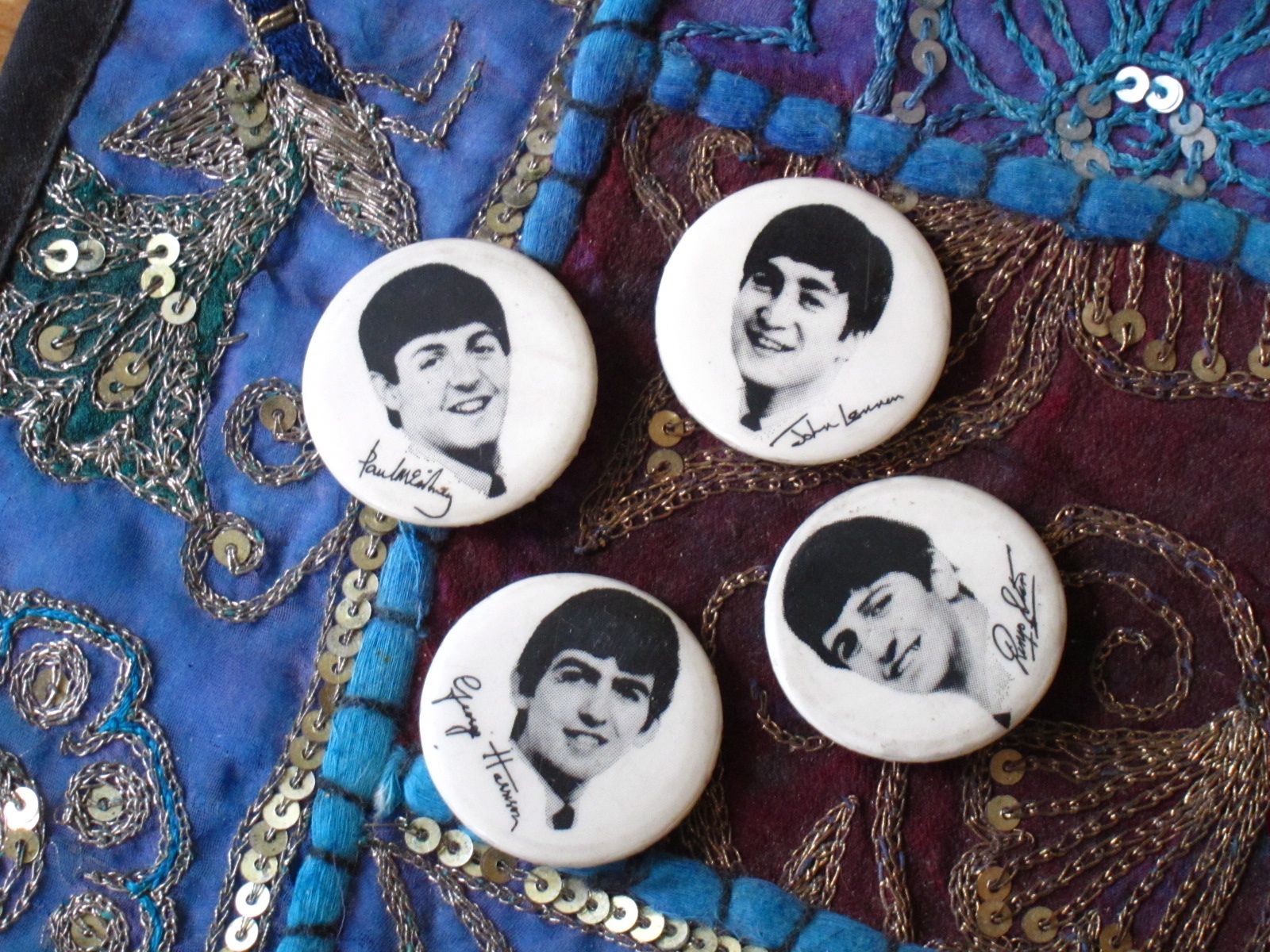
She loves you, yeah yeah yeah! I love these vintage Beatles pins that an ex girlfriend bought for me several years ago. The Beatles are an obsession for me; I know every song and every bit of trivia you can throw at me. But this type of memorabilia captures an innocence of youth long since gone, teenage girls being able to wear their favorite moptop on their lapel.
 
I collect refrigerator magnets. Anytime I travel to a new country or city I look for a magnet to commemorate my visit. They're kitschy and cool and nicely dress up the plain white surface of the cold, bulky home appliance.

I found this brass bell at the same junk store I found the WWII nurse. I like the idea of marking a special occasion with a ring of the bell. And so I do from time to time. Something along the lines of, "dinners ready!", ring-ring-ring! The ring of a bell perks the ears of angels, they say. Hopefully it brings along a bit of luck too, for me and you.


Wednesday, November 23, 2011

Rinsing Lettuce?


As we Americans approach the eating festival of the year, Thanksgiving, I would like to broach a food-topic that has caused me a bit of confusion over the years. My local grocery store displays its lettuce rather on the wet side, meaning it appears to have been washed already. The leaves are lightly blanketed in cool, crisp water. I even give it a little shake before bagging it to remove some of the dampness.

I know you are always supposed to rinse your lettuce to help ensure e coli and other bacteria have been washed off (not a total fool-proof method to be sure, but an accepted one). My point is, however, do I need to rinse this lettuce that has obviously already been sprayed with water? I mean, it seems a little redundant to rinse produce that is already quite wet.

Anyone else encountered "wet" lettuce at the grocery store and have an opinion on this?

Monday, November 14, 2011

The Farm Colony


Last week I explored the abandoned remains of the New York City Farm Colony in Staten Island with a friend, armed with my Canon FT and Holga 120. I had heard of this whole compound of various ruined buildings nestled within the weeded grounds of a 100 acre lot in the middle of Staten Island. Too enticing to pass up!


It was a beautiful Saturday afternoon. The sun was shining, the air was unseasonably warm and the leaves were still changing. We hopped in a car and followed the winding concrete path of the expressway across the Verazzano. We looped around the grounds a couple times until we found the best break in the chain link fence to make our entry. There were some houses across the street and we didn't want anyone to see us go in. So we parked in front of our secret entrance and sneaked in behind the camouflage of the car.

The compound grounds were so overgrown with vegetation, I almost felt like were were walking through the ancient Mayan temples of Guatemala. You could see the remains of paved streets but they were wrapped in vines and felled by enormous trees over ye
ars of storms. The buildings stood alone, empty shells of their former selves, crumbling away into nothingness. Windows broken, stones cracked, graffiti covering every flat surface. The insides were dark and damp, blanketed with dust inches thick. Occasionally we would see the black markings of a former camp fire, or sinister messages written in spray paint.

The story began in 1829 when the area was known as the Poor Farm, where New York's destitute could earn room and board for their manual labor on the farm. In its height the agricultural colony could produce vegetables to support 3,000 people. By 1915 there were 824 residents supervised by 150 employees housed in a series of rubble stone and brick buildings. Unfortunately, as the population of the colony aged no new, younger hands were moving in. By the end of the 1920's the site had stopped being a farm and became a housing complex for the infirm.

The Farm Colony, as it is still known, has been completely abandoned since 1975, however no funds exist to revitalize the area. It has been left to rot.


After a couple hours my friend and I bumped into a trio of goth teenagers. They were carrying metal pipes and other makeshift weapons, convinced there were lunatics running lose throughout the compound. They told us rumors of murderers and prison escapees. Even more supernatural events that were unexplainable. They said they had been there at night once. Although I was suspicious of their tales I know I wouldn't want to be there at night. It was a pleasant place to explore during the day but at night would be another story.

We bid our new found friends goodbye and headed back to the car. It was a great day and as we headed back home I thought of the former colony and wondered if it would ever get a chance to serve its community again. There would definitely be many weeds to pull if it was ever to be a farm again.